Placeholder Image
Got a photo of this dish? Upload yours to replace it!
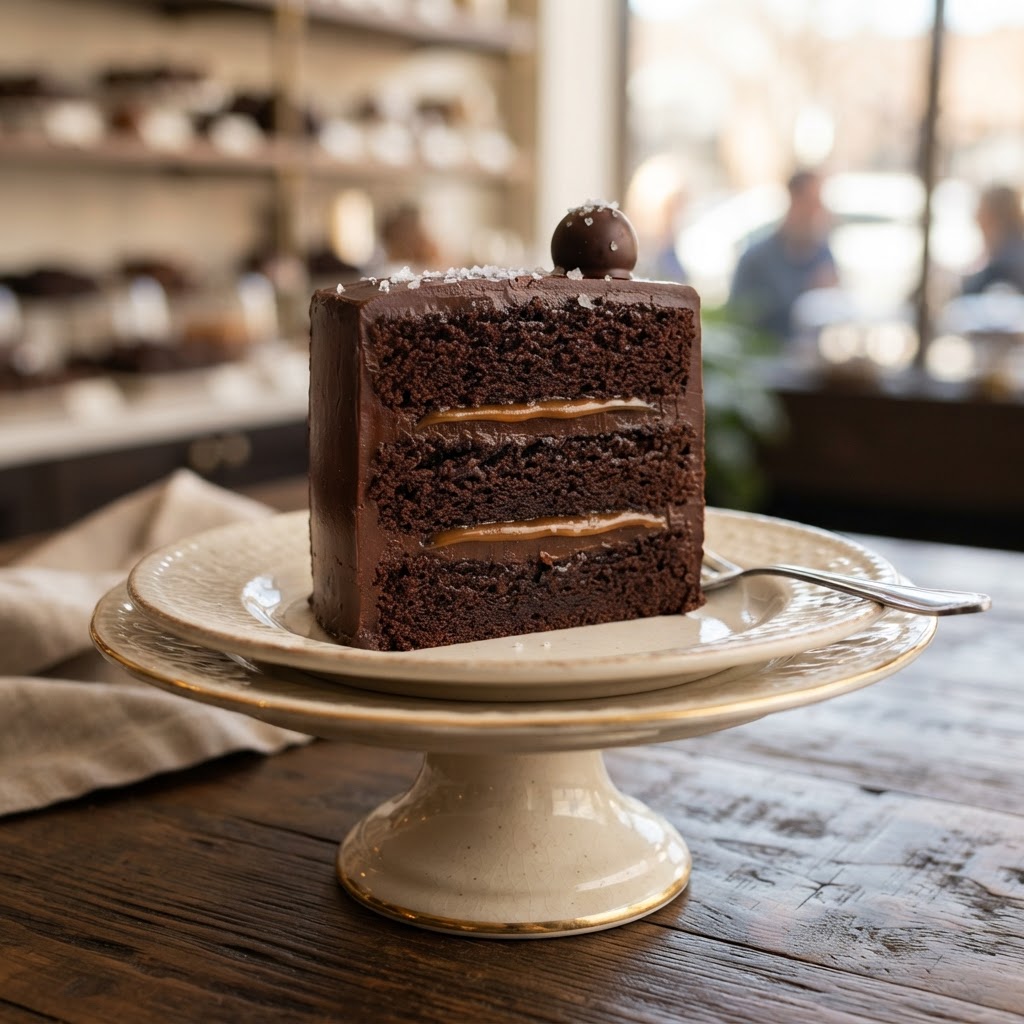
Dark Chocolate Salted Caramel Truffle Cake
A sophisticated dark chocolate layer cake filled with silky chocolate truffle ganache and thin ribbons of deeply caramelized salted caramel, then finished with dark chocolate ganache. The most decadent and technically impressive of the three cakes.
Total
330 min
Servings
16
Level
Hard
Ingredients
Dark Chocolate Cake
- 2 1/4 cup All-purpose flour, 270 g
- 3/4 cup Dutch-process cocoa powder, 68 g
- 2 tsp Baking powder
- 1/2 tsp Baking soda
- 1 tsp Fine sea salt
- 1 1/2 cup Granulated sugar, 300 g
- 1/2 cup Packed dark brown sugar, 100 g
- 3 Large eggs, room temperature
- 2 Large egg yolks, room temperature
- 3/4 cup Unsalted butter, softened, 170 g
- 1/4 cup Neutral oil, 80 ml
- 1 cup Full-fat sour cream, 240 g
- 1/2 cup Whole milk, 120 ml
- 2 tsp Pure vanilla extract
- 4 oz Bittersweet chocolate, 65–70%, melted and slightly cooled, 113 g
- 1/2 cup Hot strong coffee, 120 ml
- 1 tsp Instant espresso powder
Salted Caramel
- 1 cup Granulated sugar, 200 g
- 1/4 cup Water, 60 ml
- 6 tbsp Unsalted butter, cut into pieces, 85 g
- 1/2 cup Heavy cream, warmed, 120 ml
- 1 tsp Pure vanilla extract
- 3/4 tsp Fine sea salt
- Flaky sea salt, optional, for finishing (optional)
Truffle Ganache Filling
- 12 oz Bittersweet chocolate, 65–70%, finely chopped, 340 g
- 1 cup Heavy cream, 240 ml
- 2 tbsp Glucose syrup or light corn syrup, 40 g
- 3 tbsp Unsalted butter, 42 g
- 1/4 tsp Fine sea salt
Exterior Dark Chocolate Ganache
- 16 oz Bittersweet chocolate, 60–66%, finely chopped, 454 g
- 1 1/2 cup Heavy cream, 360 ml
- 2 tbsp Glucose syrup or light corn syrup, 40 g
- 3 tbsp Unsalted butter, 42 g
- 1/2 tsp Pure vanilla extract
- 1 pinch Fine sea salt
Instructions
Preheat oven to 350°F. Grease three 8-inch round cake pans and line bottoms with parchment.
In a medium bowl, sift together the flour, cocoa, baking powder, baking soda, and salt.
Combine the hot coffee and espresso powder. Set aside to cool slightly.
Melt 4 oz chocolate gently. Allow to cool until warm but still fluid.
In a stand mixer with paddle attachment, beat softened butter with granulated sugar and dark brown sugar approximately 3 minutes. Add neutral oil and mix until incorporated.
Add eggs one at a time. Add yolks. Scrape bowl between additions. Add vanilla. Add melted chocolate. Mix until homogeneous.
Whisk sour cream and milk together separately. Add dry ingredients and sour-cream mixture alternately: dry, dairy, dry, dairy, dry. Mix on low only until nearly incorporated.
Slowly add the warm coffee. Fold batter by hand until completely homogeneous.
Divide equally between prepared pans. Bake approximately 28–33 minutes. Cakes are done when centers are set and a tester shows moist crumbs without raw batter.
Cool 15 minutes in pans. Turn out, remove parchment, and cool completely.
Make the salted caramel — SAFETY: Hot caramelized sugar can cause severe burns. Do not touch or taste the caramel while hot. Use a sufficiently deep saucepan because adding cream causes vigorous bubbling.
Place sugar and water in a clean, heavy-bottomed saucepan. Stir gently only until all sugar is moistened. Cook over medium heat. Once boiling, stop stirring with a spoon. If necessary, gently swirl the pan for even caramelization.
Continue cooking until the syrup becomes a deep amber color. Watch closely — caramel can go from deep amber to burnt very quickly. Remove pan from heat.
Carefully add butter. The mixture will bubble vigorously. Whisk carefully. Slowly add the warm heavy cream — again expect vigorous bubbling. Return to low heat if necessary and stir until completely smooth. Remove from heat, add vanilla and sea salt, and cool completely.
Refrigerate the caramel until thick enough to use as a cake filling. It should be soft, spreadable, and slightly fluid — not watery, not hard candy, and not runny enough to escape the cake.
Make the truffle ganache filling: Place chopped chocolate in a heatproof bowl. Heat cream and glucose until steaming. Pour approximately one third over chocolate and emulsify from the center. Add remaining hot cream in two additions, continuing until smooth, elastic, and glossy. If available, finish with an immersion blender without incorporating air. At approximately 95–105°F, add butter and salt. Blend until smooth. Let set until thick and spreadable.
Make the exterior ganache: Repeat the controlled emulsion technique using the exterior chocolate, heavy cream, glucose, butter, vanilla, and salt. Allow to cool until spreadable.
Assembly — IMPORTANT: The caramel must not squirt out the sides. Use a ganache dam. Place the first cake layer on a cake board.
Pipe a ring of truffle ganache around the outer perimeter. Spread truffle ganache inside the ring. Create a shallow depression in the center of the ganache.
Spoon a thin layer of salted caramel over the ganache, staying inside the perimeter dam. Do not use so much caramel that the layer becomes unstable.
Add the second cake layer. Repeat: ganache dam, truffle filling, thin caramel layer. Add the final cake layer. Check that the cake is level.
Chill approximately 20–30 minutes to stabilize. Apply a thin crumb coat using exterior ganache. Chill briefly.
Frost the entire cake with remaining exterior ganache. Finish with elegant smooth sides or restrained ganache texture. If desired, apply a very restrained caramel detail to the top. Do not pour huge amounts of caramel over the cake merely for photography. Add a few flakes of sea salt immediately before serving if desired.
Nutrition per serving
520
Calories
7g
Protein
55g
Carbs
33g
Fat