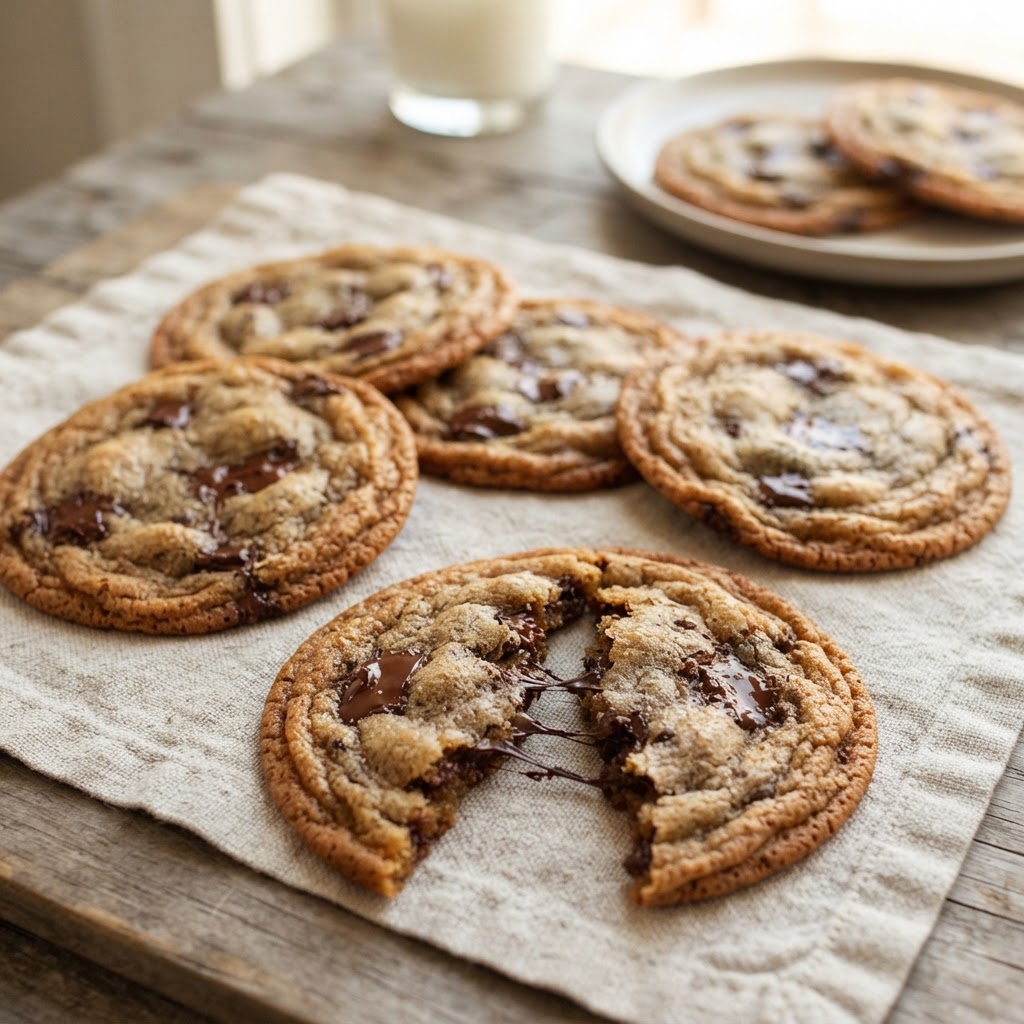
Thin, Crispy-Chewy Chocolate Chip Cookies
Make thin chocolate chip cookies with deeply crisp golden edges, chewy centers, dark brown sugar, vanilla bean paste, and bittersweet chocolate.
Ingredients
- 1 stick Salted butter, melted and cooled to approximately 85-95°F, 113 g
- 140 g Dark brown sugar
- 70 g Granulated sugar
- 1 Large egg yolk
- 1 tbsp Heavy cream, 15 g
- 1 tsp Vanilla bean paste, 5 g
- 140 g All-purpose flour
- 1/2 tsp Fine salt, 2 g
- 1/2 tsp Baking soda, 2 g
- 140 g Bittersweet chocolate, roughly chopped or in chunks
- Flaky sea salt, for finishing, optional
Instructions
- Preheat oven to 350°F and line baking sheets with parchment paper.
- Melt the salted butter, then cool it to approximately 85-95°F. It should be fully melted but warm, not hot. This helps control spread, emulsification, dough texture, and final chew.
- In a mixing bowl, combine the melted butter, dark brown sugar, and granulated sugar. Whisk until smooth and glossy.
- Add the egg yolk. Whisk until fully emulsified.
- Add the heavy cream and vanilla bean paste. Whisk until smooth.
- In a separate bowl, whisk together the all-purpose flour, fine salt, and baking soda.
- Add the dry ingredients to the wet ingredients. Fold only until almost combined. Do not overmix.
- Fold in the bittersweet chocolate. Mix only until no dry flour remains.
- Portion into 12 equal cookies. For consistency, weigh the total dough and divide by 12 where practical.
- Place cookies well-spaced on prepared baking sheets. These cookies are intentionally designed to spread — do not crowd the pan.
- Bake until cookies have spread thin, outer edges are a deep golden brown, centers remain slightly softer than the edges, the middle is no longer raw, and the chocolate is melted. Do not overbake until the entire cookie is hard — the cookies continue setting as they cool.
- Let cookies cool on the baking sheet for approximately 5-10 minutes. This is important for the final texture.
- Transfer carefully to a wire rack and cool further. The intended crisp-edges, chewy-center texture becomes more distinct as the cookies cool.
Nutrition
Chef's Notes
Adapted from @DavesPizzaOven. WHY THIS FORMULA WORKS: • Dark brown sugar provides molasses, deeper caramel flavor, moisture, and chew. • Granulated sugar helps encourage spread and crisp edges. • Melted butter promotes a denser, chewier cookie and more spread than creamed butter. • Egg yolk adds richness and chew without the extra water/protein of a whole egg. • Heavy cream provides a small amount of additional moisture and fat. • Vanilla bean paste adds strong vanilla flavor and visible vanilla character. • Bittersweet chocolate balances the sweet dough with deeper cocoa flavor. CHEF'S NOTES: 1. Butter temperature matters — do not mix the dough with very hot butter. Cool melted butter to approximately 85-95°F. 2. Space the cookies well — these are intentionally thin spreading cookies. Allow plenty of room between portions. 3. Do not overbake — for the intended chewy center, remove the cookies when the edges are deeply golden but the center still looks slightly softer. 4. Cool on the pan — the cookies continue setting on the hot baking sheet. 5. Chocolate quality matters — use a good bittersweet chocolate because chocolate makes up a substantial portion of this dough. OPTIONAL FINISH: A small pinch of flaky sea salt immediately after baking. STORAGE: Store fully cooled cookies in an airtight container at room temperature for approximately 3-4 days. For best crisp-chewy contrast, serve the same day or next day. Freeze baked cookies airtight for approximately 2-3 months. If storing portioned dough before baking, note that chilling can reduce spread and may change the exact thin-cookie result — do not turn chilling into a mandatory step. SCALING: 1× = 12 cookies, 0.5× = approximately 6 cookies, 1.5× = approximately 18 cookies, 2× = approximately 24 cookies. Scaling changes the number of cookies, not cookie diameter. Keep portion size consistent. Bake time should not mathematically scale — bake additional sheets or batches as needed. PARTIAL EGG YOLK: This recipe uses 1 egg yolk. If scaling creates a partial yolk, beat the yolk until smooth and measure the required portion by weight. Do not silently round to a full yolk.