Restaurant-Style Double-Fried French Fries
Make restaurant-style French fries at home with a two-stage frying method for deeply crisp golden exteriors and fluffy potato centers.
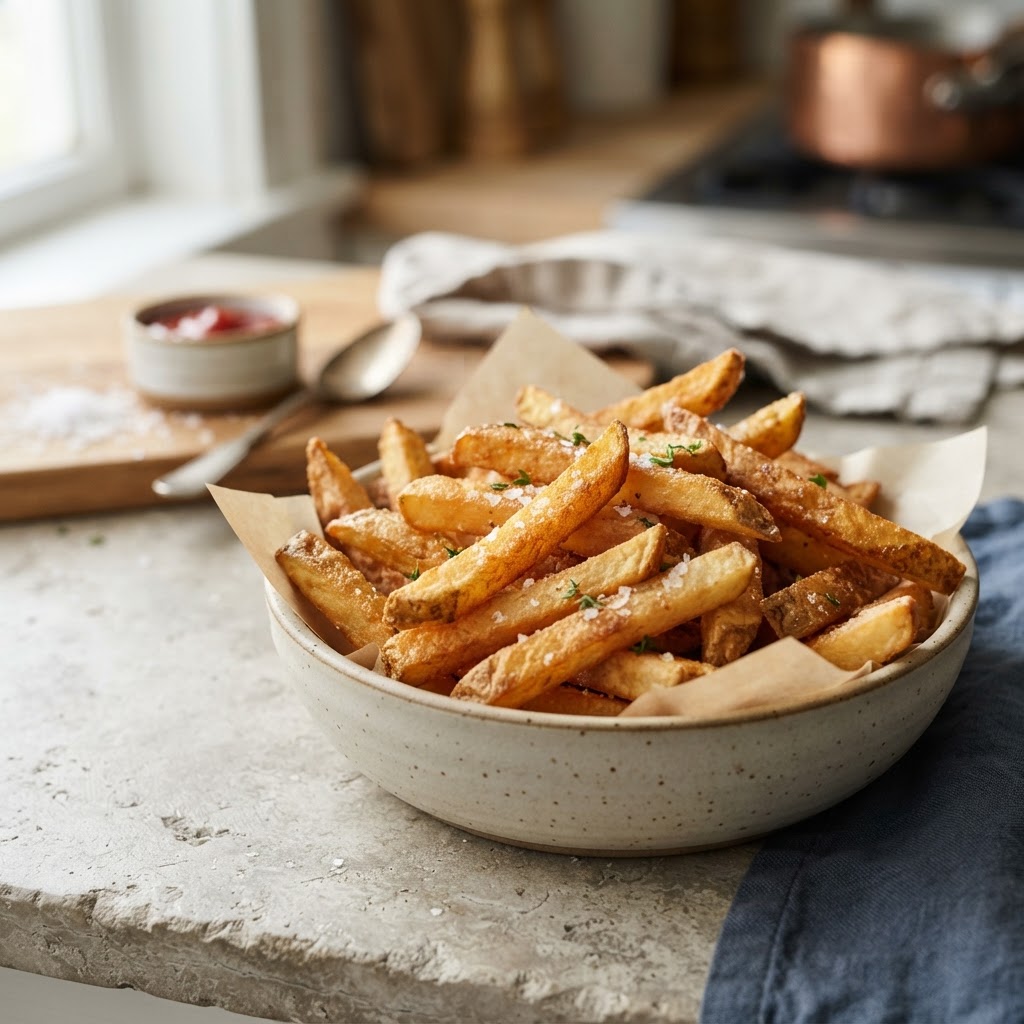
Ingredients
- 2 lb lb Russet potatoes, about 900 g
- enough for 3 inches depth cups Neutral high-heat frying oil, approximately 6 cups depending on pot size
- to taste pinch Kosher or fine sea salt
- to taste pinch Flaky sea salt (optional finish)
Instructions
- Scrub and peel the potatoes. Leaving some skin on is acceptable as an optional variation, but the canonical restaurant-style version uses peeled russets.
- Square off the potatoes where practical and cut lengthwise into approximately 1/4-inch slabs.
- Cut the slabs into approximately 1/4-inch fries. Aim for consistent thickness so they cook evenly.
- Immediately place cut potatoes in a large bowl of cold water. Agitate with your hands.
- Drain the cloudy water and refill with fresh cold water.
- Soak the potatoes for at least 30 minutes. For make-ahead preparation, refrigerate submerged potatoes for several hours.
- Drain thoroughly and spread the potatoes over clean kitchen towels. Pat COMPLETELY dry. Water and hot frying oil are dangerous — the fries must be thoroughly dried before entering the oil.
- FIRST FRY: Heat frying oil to 325°F (163°C) using a deep-fry thermometer.
- Add fries in small batches. Do not overcrowd the pot.
- Fry for approximately 5 to 7 minutes until the potatoes are cooked through, the surface looks pale/blond, and the fries remain flexible with little significant browning. This stage cooks the potato, not final browning.
- Remove with a spider strainer and transfer to a wire rack set over a sheet pan. Do not pile hot fries deeply on paper towels.
- Repeat with remaining fries.
- COOLING STAGE: Allow first-fried potatoes to cool for at least 20 minutes. For an even stronger restaurant-style workflow, cool completely before final frying. The first fry cooks and dehydrates the potato; cooling lets the exterior lose additional moisture and firms the structure before the high-temperature finishing fry.
- SECOND FRY: Increase oil temperature to 375°F (190°C).
- Working in batches, return cooled fries to the oil.
- Fry for approximately 2 to 4 minutes until deep golden, crisp, lightweight-looking, and audibly crisp when moved.
- Remove to a rack and season IMMEDIATELY with salt while the surface oil is still hot.
- Serve immediately.
Chef's Notes
WHY DOUBLE FRY? FIRST FRY: Cooks the potato interior and begins moisture removal at a lower temperature (325°F / 163°C). COOLING: Allows steam and moisture to escape and the exterior to firm before the high-temperature finishing fry. SECOND HOTTER FRY: Rapidly dehydrates and browns the exterior at 375°F (190°C) for the crisp shell. This is not an arbitrary extra step — each stage serves a distinct purpose. BEST POTATO: Russets are preferred because their relatively high starch and lower moisture are well suited to crisp fries with fluffy centers. TEMPERATURE RECOVERY: Do not fill the pot with too many fries. Large batches dramatically lower oil temperature and encourage greasy, limp fries. SALTING: Salt immediately after the second fry while the surface is still hot and slightly oily so the salt adheres. MAKE-AHEAD: The first fry can be performed ahead of service. Cool completely and refrigerate appropriately before the final fry. SCALER NOTE: At 1.5x and 2x, increase the NUMBER OF BATCHES. Do NOT simply put twice as many potatoes into the fryer at once. FRYING SAFETY: - Use a deep heavy pot with ample headspace. - Do not fill the pot excessively with oil (maximum halfway). - Dry potatoes thoroughly before frying. Never add wet potatoes to hot oil. - Use a thermometer to monitor oil temperature. - Do not leave frying oil unattended. - Do not overcrowd the pot. Fry in batches. - Never use water to extinguish an oil fire. Keep a lid nearby to smother flames. WHY RESTAURANT FRIES GET CRISPY: The secret is not a single trick but a combination of techniques that most home cooks skip: 1. SURFACE STARCH REMOVAL: Soaking cut potatoes in cold water draws out surface starch. Excess starch burns and turns gummy instead of crisp. 2. MOISTURE CONTROL: Potatoes are approximately 80% water. Water and hot oil are a dangerous combination. Thorough drying is both a safety and a crispness step. 3. OIL TEMPERATURE: Restaurant fries use two different oil temperatures. The first, lower-temperature fry cooks the potato interior. The second, hotter fry rapidly dehydrates and browns the exterior. 4. BATCH SIZE: Overcrowding drops oil temperature dramatically. Cold oil produces greasy, limp fries. Fry in small batches. 5. COOLING BETWEEN FRIES: The cooling stage lets the exterior lose additional moisture and firms the structure before the high-temperature finishing fry. This is not optional filler — it is the core of the technique. 6. ROUGHING THE SURFACE (for home fries): Parboiling with a small amount of baking soda softens the potato exterior. Shaking the drained potatoes creates a rough, starchy coating that fries into an exceptionally crunchy crust.