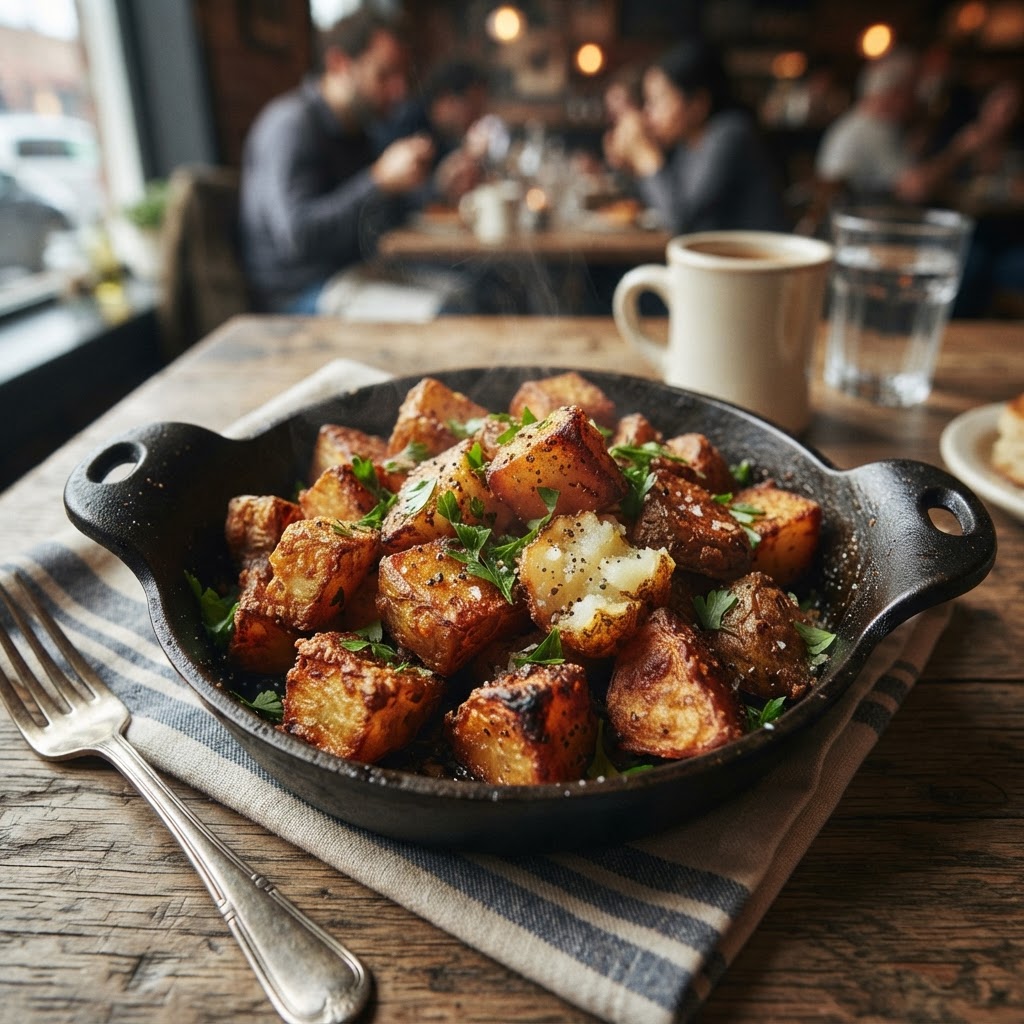
Extra-Crispy Rough-Edge Home Fries
Make extra-crispy home fries by parboiling potatoes, steam-drying them, and shaking them until rough and fluffy before frying until deeply crunchy.
Ingredients
- 2 lb lb Russet or Yukon Gold potatoes, about 900 g
- 1 tbsp tbsp Kosher salt (for cooking water)
- 1/4 tsp tsp Baking soda
- enough for 1 to 1 1/2 inches depth cups Neutral high-heat frying oil, approximately 3 cups
- to taste pinch Fine sea salt or kosher salt
- to taste pinch Freshly ground black pepper
- 1 tbsp tbsp Fresh parsley, finely chopped (optional)
- 1 tbsp tbsp Fresh chives, finely sliced (optional)
Instructions
- Cut the potatoes into approximately 1 1/4-inch chunks. Irregular chunky shapes are acceptable and can actually create more interesting crisp edges.
- Bring a large pot of water to a boil. Add 1 tablespoon kosher salt and 1/4 teaspoon baking soda.
- Add the potato chunks and return to a controlled boil.
- Cook for approximately 7 to 9 minutes. IMPORTANT: The potatoes should NOT be completely falling apart. Desired state: centers partially cooked, outer few millimeters softened, edges beginning to look slightly fuzzy, potatoes still structurally intact.
- Drain very carefully.
- STEAM DRY: Allow drained potatoes to sit in the colander for approximately 5 minutes. Steam should visibly escape and the exterior should become relatively dry. Wet potatoes will not crisp properly and are unsafe around hot oil.
- THE ROUGH-EDGE BOWL TECHNIQUE: Transfer warm drained potatoes to a LARGE mixing bowl.
- Toss and shake the bowl firmly approximately 10 to 20 times. BEFORE: smooth potato chunks. AFTER: rough, fuzzy, slightly mashed-looking exterior with crumbly starchy edges. Do NOT completely smash the potato chunks — the centers must remain intact.
- Spread the roughed potatoes onto a tray while the oil heats.
- Heat approximately 1 to 1 1/2 inches of neutral oil in a heavy skillet or Dutch oven to 350°F (175°C).
- Add potatoes in batches. Do not crowd.
- Fry, turning periodically, for approximately 10 to 15 minutes total until deeply golden, craggy, crisp on multiple surfaces, and fluffy inside. Use visual texture as the primary endpoint — exact time varies according to chunk size, oil depth, batch size, potato variety, and temperature recovery.
- Remove to a wire rack.
- Season immediately with salt and black pepper.
- Finish with parsley and chives if desired.
Chef's Notes
WHY BAKING SODA? A SMALL amount of baking soda raises the alkalinity of the cooking water and helps soften the potato exterior. This encourages the outside to break down slightly during parboiling. When the potatoes are later tossed/shaken, that softened exterior turns into a rough starchy coating that becomes exceptionally crisp during frying. Do NOT use excessive baking soda. The potatoes should not taste alkaline. THIS TECHNIQUE IS THE POINT OF THE RECIPE. The canonical technique is: PARBOIL → DRAIN → STEAM DRY → SHAKE/TOSS AGGRESSIVELY → CREATE ROUGH STARCHY EDGES → FRY. Do not simplify this into boil-potatoes-drain-fry-potatoes. The potatoes should look almost TOO rough before frying. That fluffy surface becomes the crunchy crust. If they remain perfectly smooth after boiling: they were probably not cooked enough to rough up effectively. If they completely collapse: they were overboiled or shaken too aggressively. SCALER NOTE: At 1.5x and 2x, increase the NUMBER OF BATCHES. Do NOT simply put twice as many potatoes into the skillet at once. FRYING SAFETY: - Use a deep heavy pot with ample headspace. - Do not fill the pot excessively with oil (maximum halfway). - Dry potatoes thoroughly before frying. Never add wet potatoes to hot oil. - Use a thermometer to monitor oil temperature. - Do not leave frying oil unattended. - Do not overcrowd the pot. Fry in batches. - Never use water to extinguish an oil fire. Keep a lid nearby to smother flames. WHY RESTAURANT FRIES GET CRISPY: The secret is not a single trick but a combination of techniques that most home cooks skip: 1. SURFACE STARCH REMOVAL: Soaking cut potatoes in cold water draws out surface starch. Excess starch burns and turns gummy instead of crisp. 2. MOISTURE CONTROL: Potatoes are approximately 80% water. Water and hot oil are a dangerous combination. Thorough drying is both a safety and a crispness step. 3. OIL TEMPERATURE: Restaurant fries use two different oil temperatures. The first, lower-temperature fry cooks the potato interior. The second, hotter fry rapidly dehydrates and browns the exterior. 4. BATCH SIZE: Overcrowding drops oil temperature dramatically. Cold oil produces greasy, limp fries. Fry in small batches. 5. COOLING BETWEEN FRIES: The cooling stage lets the exterior lose additional moisture and firms the structure before the high-temperature finishing fry. This is not optional filler — it is the core of the technique. 6. ROUGHING THE SURFACE (for home fries): Parboiling with a small amount of baking soda softens the potato exterior. Shaking the drained potatoes creates a rough, starchy coating that fries into an exceptionally crunchy crust.